


The Luxury Dog Bed Was Once Used as Evidence of a Woman's Moral Failure
This may surprise you. For centuries, giving your dog a beautiful bed was not considered an act of love. It was considered evidence of a woman's moral corruption.
Not many people know this. But the history of the luxury dog bed is, in large part, the history of what women have been told they are not allowed to have.
The Print That Started This

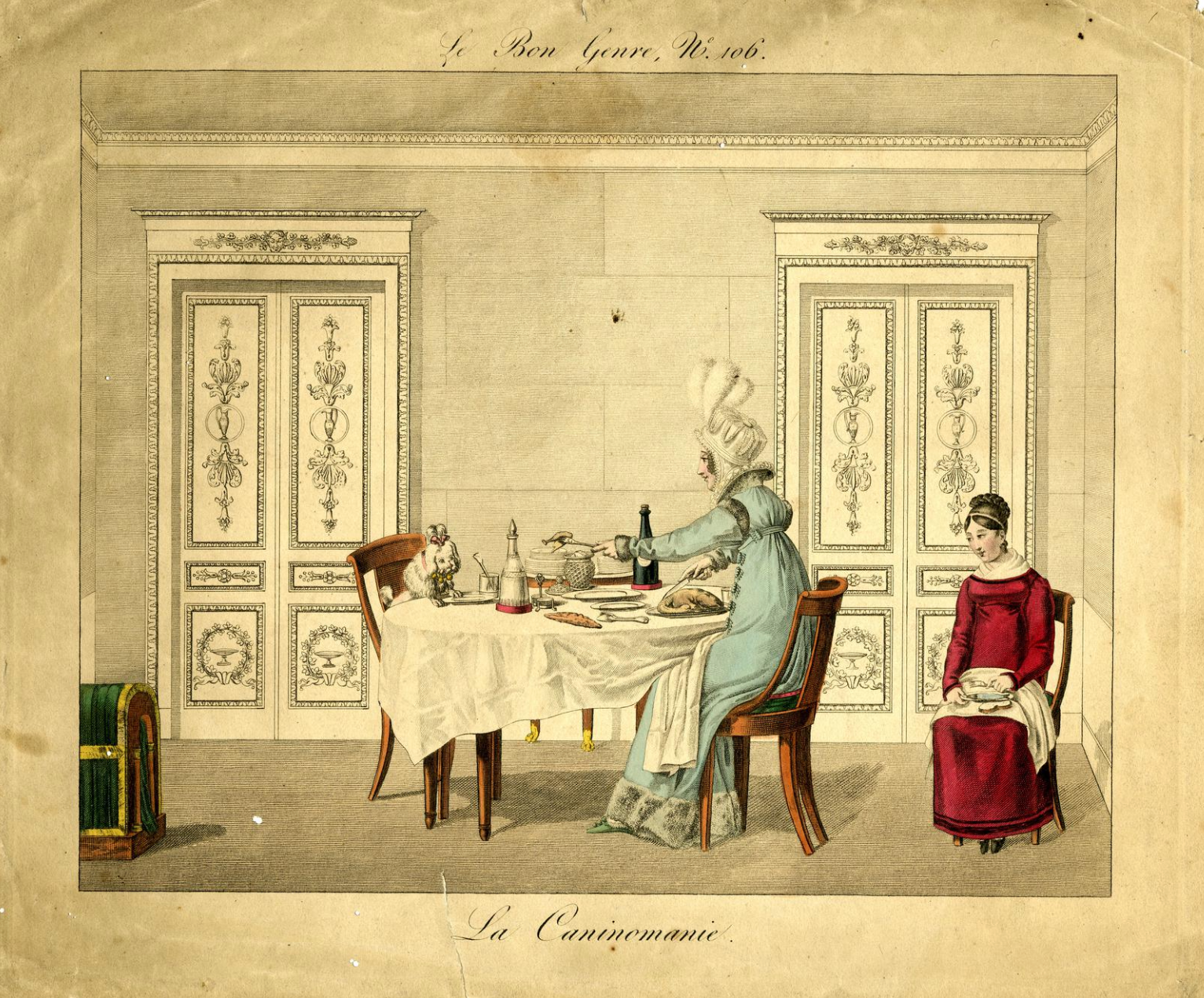
In 1818, an anonymous French satirical print was published under the title La Caninomanie — Dog Mania. It depicts a well-dressed woman sitting at a dinner table, feeding her lapdog from her own fork. To her right, her daughter sits alone on a chair, away from the table, eating herring from her lap.
To the left of the print, almost as a footnote, sits a dog bed. A niche à chien. A small, cushioned, carefully made piece of furniture built for the comfort of a dog.
The British Museum, which holds the print in its collection, describes the scene plainly: a lady eats on one side of a round table, her dog eats at the other, while her daughter eats by herself on a chair at the side.
The dog bed was not incidental to the image. It was the point of it. Physical evidence, placed deliberately in frame, of a woman's excess. Her priorities, rendered visible. Her failure, on display.
This Was Not an Isolated Image

La Caninomanie was one of hundreds. Throughout the 18th and early 19th centuries, satirists, moralists, and male commentators produced a sustained, coordinated campaign against women who lavished attention on pet dogs. The British Museum's collection alone contains multiple prints from this period, each one using the same visual language: the woman, the dog, the evidence of care directed somewhere it was not supposed to go.
Historians of pets and gender have documented this recurring trope extensively. Dr. Stephanie Howard-Smith, who completed her PhD on the cultural history of dogs in the long 18th century at Queen Mary University of London, has written specifically about how dog furniture — dog beds, dog chairs, dog kennels — became associated in satirical art with particularly excessive, morally suspect modes of female pet-keeping.
The criticism was not subtle. It linked pet-keeping explicitly to vanity, sentimentality, luxury, and the neglect of domestic duties. Women who loved their dogs too openly were publicly condemned. Men declared themselves shocked. Pamphlets were written. Pulpits were used. The message was consistent and clear: a woman who gave her dog a bed was a woman who was failing.
Failing as a mother. Failing as a wife. Failing, most fundamentally, as a moral being.
What They Were Really Saying

It is tempting to read this as simple excess policing — the kind of moral panic that surfaces in every era when women spend money on things men find frivolous. But the history is more specific than that, and more revealing.
The satire was not directed at women who loved too much. It was directed at women who loved something that served no patriarchal purpose whatsoever.
A child extended the family line. A child justified the woman's existence within the household, validated her role, produced an heir, continued the name. Care directed at a child was care that served the system.
A dog served none of these functions. A dog gave a woman pleasure and companionship entirely on her own terms. It did not require her to be a mother, a wife, a daughter, or a moral exemplar. It simply loved her back, without condition or expectation. It asked nothing of her except company.
In the 18th century, a woman who had something purely for herself — something that returned love without requiring justification — was a woman who needed to be corrected.
The dog bed was the proof. Not of excess, but of autonomy. And autonomy, in a woman, was the thing they could not tolerate.
The Weapon of Shame
What makes this history particularly striking is not that women were mocked. Women have always been mocked. It is that the mechanism of mockery was so specifically domestic.
They did not attack women's intelligence, or their politics, or their capacity for public life. They attacked them through their kitchens, their dining rooms, their drawing rooms. Through the objects that surrounded them in the spaces they were confined to. Through the evidence of where their care went and what it was spent on.
The luxury dog bed was weaponised because it was visible. It sat in the room. It could be pointed at. It could be drawn. It could be placed in a satirical print next to a neglected daughter and shown to the world as evidence of everything that was wrong with women who dared to find comfort and pleasure in something that was entirely, unapologetically their own.
What This Means Now
The satire stopped, eventually. The pamphlets faded. The prints collected dust in museum archives.
But the instinct behind them — the discomfort with women who claim things for themselves, who direct care and resources toward something that serves their own joy rather than the expectations placed upon them — that instinct did not disappear. It simply found different forms.
Every woman who has ever been told she loves her dog too much, spends too much on her dog, cares too deeply about her dog's comfort is, whether she knows it or not, the subject of a print that was made in 1818.
The dog wasn't the problem. A woman having something purely for herself was.
I'll let you decide if that's changed.
Enid Blythe makes luxury orthopedic dog beds designed to belong in a beautiful interior. Five percent of our yearly profit goes to canine cancer research — in memory of Atticus, and for every dog who deserves more time.
Sources: British Museum Collection (1982,U.1375; 1898,0520.161); Dr. Stephanie Howard-Smith, 'Lapdogs and Other People: The Representation of Toy Dogs in Eighteenth-Century British Culture', Queen Mary University of London (2018); Pet Histories, 'In the Dog House: Canine Furniture in the Eighteenth Century' (2019).
Leave a comment
This site is protected by hCaptcha and the hCaptcha Privacy Policy and Terms of Service apply.