


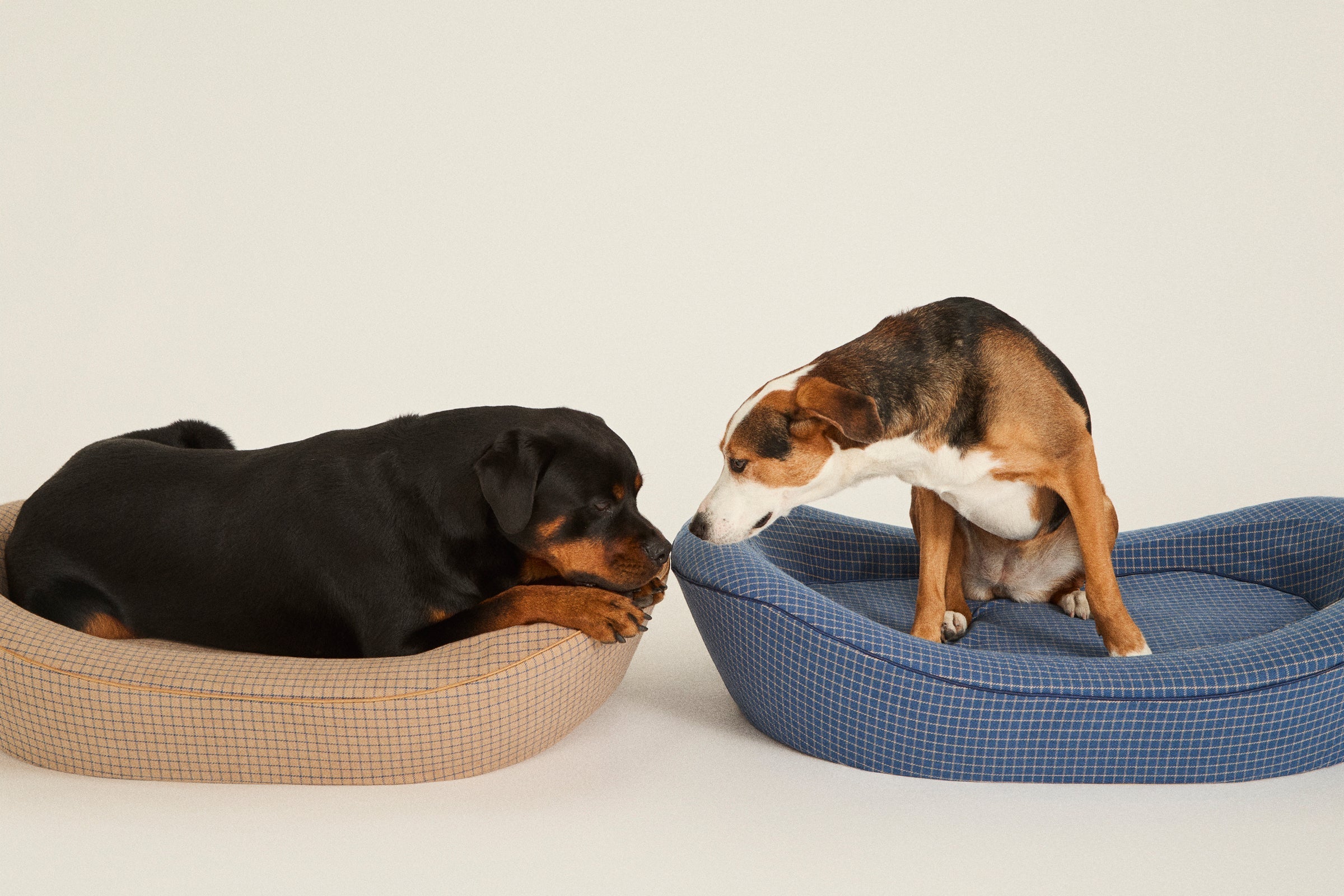
Can a Dog Bed Be Too Big or Too Small? How to Get the Size Right
It is one of the most common questions dog owners face when buying a new bed — and one of the most frequently answered incorrectly. The assumption tends to be that bigger is always better, that a generous bed is a kind bed. In reality, the wrong size in either direction can undermine the very comfort and support you are trying to provide.
Here is what the science says, what your dog's sleeping style tells you, and how to find the size that is genuinely right for them.
Dogs Are Den Animals — and Size Matters Because of It
To understand why bed size affects a dog's comfort, it helps to understand something fundamental about how dogs experience space. Dogs are descended from den-dwelling animals. Their instinct is to seek out enclosed, bounded spaces that feel secure — places where they can rest without vulnerability, with their back protected and their surroundings defined. This is why so many dogs gravitate toward the space under a table, the corner of a room, or the gap behind a sofa. It is not a quirk. It is biology.
A bed that is dramatically oversized can work against this instinct. Rather than feeling like a sanctuary, it can feel exposed and undefined — a flat expanse without boundaries rather than a contained, secure resting place. Research into canine resting behavior consistently shows that dogs sleep more deeply and more calmly in spaces that match their body size and provide some sense of enclosure.
This does not mean a dog should be cramped. It means the bed should fit the dog — not dwarf them, and not confine them.
Should a Dog Bed Be Small or Big?
The honest answer is: it depends on your dog, and specifically on how your dog sleeps.
Dogs fall broadly into two sleeping styles. Curlers tuck their legs beneath them and bring their body into a compact, rounded shape — this is a thermoregulatory and instinctive behavior, often seen in dogs who feel the cold or who have a stronger den instinct. For a curler, a snugger bed with raised sides can feel deeply comfortable, providing the bounded, enclosed quality their instincts seek.
Stretchers sprawl — legs extended, body fully elongated, often on their side or back. For these dogs, a bed that cannot accommodate their full stretched length will result in legs hanging off the edge, pressure concentrated on joints rather than distributed evenly across the surface, and a general inability to reach the deep, restorative sleep that full-body relaxation enables.
The practical rule is this: measure your dog from the base of the neck to the base of the tail, then add between six and twelve inches. That is the minimum interior length your dog's bed should be. A dog who cannot fully extend when they choose to is a dog whose sleep quality — and joint health over time — is being compromised by their bed.
If your dog is between sizes, size up. The cost of a slightly generous bed is nothing compared to the cost of years of inadequate support.
What Size Dog Bed for a Golden Retriever?
A Golden Retriever typically weighs between 55 and 75 pounds and measures between 22 and 24 inches from neck to tail. When you account for the additional length needed for comfortable extension, a Golden Retriever requires a bed with an interior length of at least 28 inches.
They are an active, physically demanding breed with a known predisposition to hip dysplasia and joint issues as they age — which makes orthopedic support in the correct size not just a comfort consideration but a long-term health one.
Enid Blythe Dog Beds: Finding the Right Fit
Enid Blythe beds were designed from the beginning with large breeds in mind — breeds who have long been underserved by the luxury end of the dog bed market. Finding an orthopedic bed for a big dog that doesn't look like it belongs in a kennel has historically been surprisingly difficult. Every Enid Blythe bed features elevated cushioned sides for head resting, high-density memory foam for genuine orthopedic support, and 100% cotton removable covers — in a size range that goes all the way up to dogs who weigh over 100 pounds.
Here is the full size guide.
Small
Interior: 20" L × 13" W × 4" H | Exterior: 29" L × 21" W × 6" H
Ideal for: Pomeranian, Chihuahua, Dachshund, Yorkshire Terrier, Pug
Medium
Interior: 25" L × 17" W × 5.5" H | Exterior: 31" L × 24" W × 7.25" H
Ideal for: Corgi, French Bulldog, Cavapoo, Cavalier King Charles Spaniel, West Highland Terrier
Large
Interior: 28.5" L × 19" W × 8" H | Exterior: 42.5" L × 31" W × 10.5" H
Ideal for: English Bulldog, American Pit Bull Terrier, Schnauzer, Goldendoodle, Poodle, Dalmatian, Vizsla, American Staffordshire Terrier, Golden Retriever, Labrador
2XL — Extra Extra Large
Interior: 43" L × 28" W × 8.5" H | Exterior: 60" L × 43" W × 11.5" H
Ideal for: Greyhound, Alaskan Malamute, Rottweiler, Bullmastiff, Greater Swiss Mountain Dog, Great Dane, Great Pyrenees, St. Bernard, Cane Corso
A Note on Giant Breeds — and Why the 2XL Matters
The Enid Blythe 2XL is, frankly, rare. At 60 inches long and 43 inches wide, it is one of very few luxury orthopedic dog beds on the market built to genuinely accommodate giant breeds — dogs who have, for too long, been forced to choose between adequate support and any semblance of considered design. A Great Dane deserves an orthopedic bed as much as a Chihuahua. A St. Bernard spending fourteen hours a day on a surface that is too small or too thin for their frame is accumulating joint stress with every night's sleep.
The 2XL was personal. Atticus, the Rottweiler for whom Enid Blythe was built, weighed 100 pounds. He fit in the Large bed — just — but in the 2XL he was, without question, in his element. The bed was generous enough that we could lie in it together, and we did. There is something that stays with you about a dog that size finally having a space that is entirely and properly his. Giant breeds deserve that. They have been an afterthought in the luxury pet market for long enough.
When in Doubt, Size Up
A bed that is slightly generous is far better than one that is slightly too small. The den instinct matters — but it is served by the raised sides and defined structure of the bed, not by constricting the sleeping area. A dog who can stretch when they want to, curl when they want to, and rest their head on an elevated bolster side whenever they choose is a dog whose bed is working for them in every position and every mood.
That is what a well-sized bed should do. Not impose a shape on your dog — simply be ready for whatever shape they need.
Enid Blythe makes luxury orthopedic dog beds for every breed, from Chihuahuas to Great Danes.
Leave a comment
This site is protected by hCaptcha and the hCaptcha Privacy Policy and Terms of Service apply.