


Where Should You Put a Dog Bed? The Complete Guide to Dog Bed Placement
Most dog owners spend considerable time choosing the right bed. Far fewer spend any time thinking about where to put it. And yet placement affects everything — how well your dog sleeps, how secure they feel, how they behave in the home, and whether the bed becomes a genuinely useful part of your daily life together or simply an object that gets ignored in favor of the sofa.
Here is what the science, and experience, actually suggests.
Where to Put a Dog Bed in the House: Start With the Dog, Not the Room
Before thinking about rooms, it helps to understand two things about dogs that are somewhat in tension with each other: they are den animals, and they are deeply social.
The den instinct is well-established. Dogs' wild ancestors sought out enclosed, protected spaces to rest — places where their back was covered, their surroundings were defined, and they could observe their environment without feeling exposed. This is why so many dogs gravitate toward corners, the space beneath a coffee table, or the gap behind a sofa. A bed placed in the middle of an open room, with activity and foot traffic on all sides, works against this instinct. It offers no sense of enclosure or security, and dogs will often abandon it in favor of a spot that feels more contained.
But dogs are also intensely social animals. Millennia of domestication have shaped them to be profoundly attuned to human presence — to seek proximity to their family, to monitor what the household is doing, and to feel most settled when they are part of the group rather than separated from it. A dog banished to a quiet back room for the sake of tidiness is a dog who is likely to feel isolated, which can contribute to anxiety and the behavioral expressions that come with it.
The answer is not either/or. It is both.
The Case for Two Beds
My strong view, shaped both by experience and by what the science of canine behavior supports, is that most dogs benefit from two beds in two different locations.
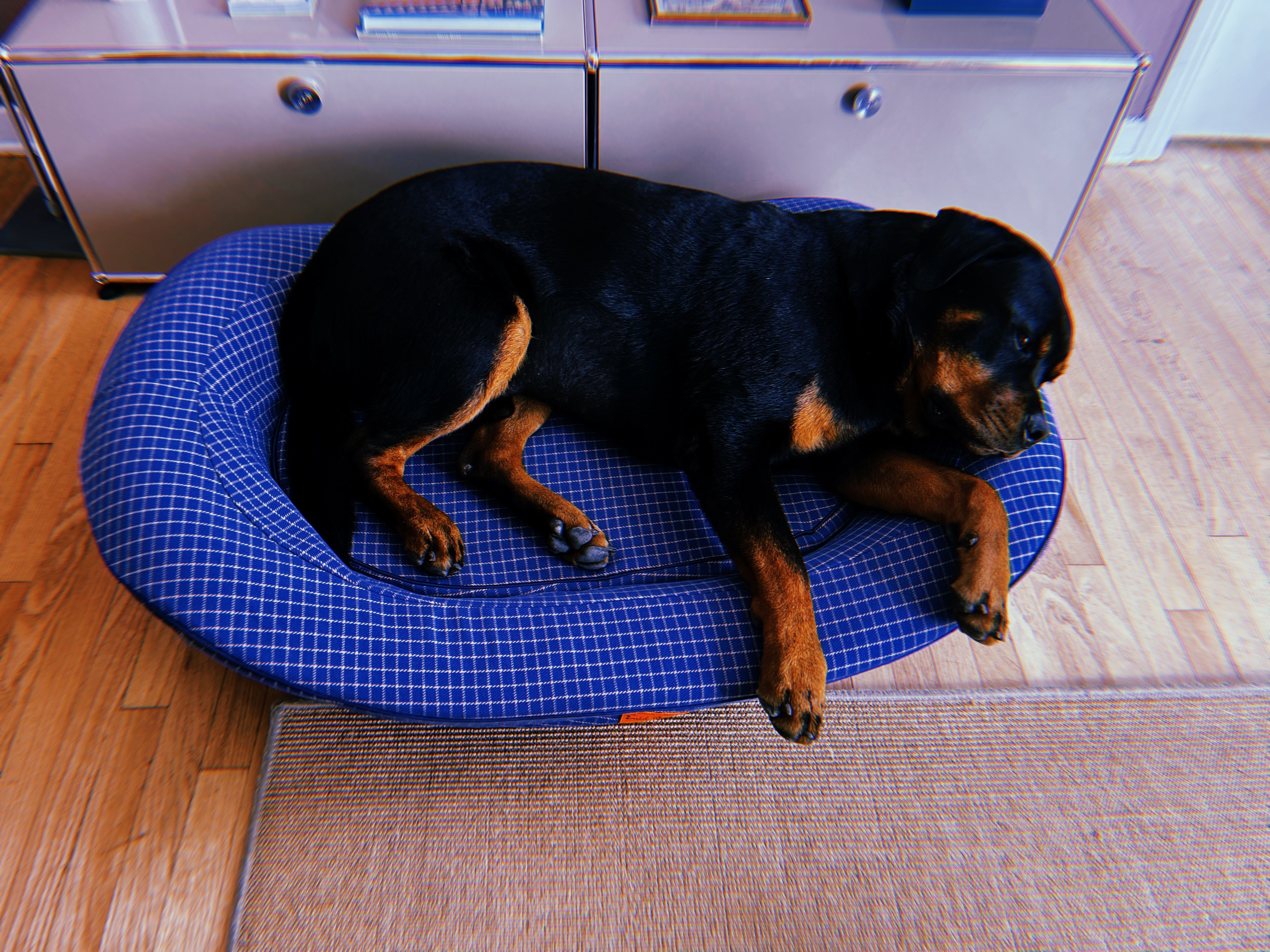
The first bed should be in the main room where you spend most of your time — the living room, the kitchen, wherever the household actually lives. This is the social bed. It is where your dog can rest while remaining part of the family, where you can use it for training the "place" command, and where your dog can choose proximity to you without needing to be on the furniture to feel included. A dog who has a beautiful, comfortable bed in the heart of the home is a dog who has been given a proper seat at the table — literally and figuratively.
The second bed should be in a quieter location — a bedroom, a hallway, a corner of a room that sees less traffic. This is the retreat bed. Dogs, like people, sometimes need to withdraw — to process the day, to sleep deeply without interruption, to simply be alone. Providing a dedicated space for this is not isolating your dog. It is respecting that they have their own need for quiet, and that being able to choose between company and solitude is itself a form of freedom.
Where to Put a Dog Bed in the Bedroom
The question of whether a dog should sleep in the bedroom is one that research has examined with increasing interest, and the findings are more reassuring than the conventional wisdom might suggest. Studies have found that many owners report sleeping as well, or nearly as well, with their dog in the room as without — and for the dog, proximity to their owner during sleep appears to reduce anxiety and support a sense of security.
Whether your dog sleeps in your bedroom is ultimately a personal choice, and one this post will not adjudicate. But if you do want a bed in the bedroom, placement matters just as much there. Position it away from the door — foot traffic in and out during the night will disrupt light sleep — and away from direct drafts from windows or air conditioning vents. A corner placement, with two walls offering a sense of enclosure, tends to work well for most dogs.
The Science of Temperature and Where You Place a Dog's Bed
One of the most overlooked considerations in dog bed placement is temperature — and it matters more than most owners realize.
Dogs maintain a resting body temperature of between 99°F and 102.5°F, running naturally warmer than humans. Their primary cooling mechanism is panting, supplemented by minimal sweat gland activity in the paw pads — which means, unlike humans, they cannot regulate heat across their whole body surface. They are almost entirely dependent on their environment to help them manage temperature during sleep.
Breeds vary significantly in their temperature sensitivity. Brachycephalic breeds — French Bulldogs, Pugs, English Bulldogs — have compromised airways that make panting less effective, making them particularly vulnerable to heat. Double-coated breeds like Huskies, Malamutes, and Bernese Mountain Dogs have insulating undercoats that retain body heat. Giant breeds generate higher metabolic heat output due to body mass. At the other end of the spectrum, toy and small breeds like Chihuahuas and Yorkshire Terriers have a high surface-area-to-mass ratio that causes them to lose heat quickly — they feel the cold far more acutely. Thin-coated breeds like Greyhounds and Whippets have minimal insulation and benefit from warmer sleeping environments. Senior dogs, with reduced circulation and metabolic rate, also tend to run cooler and benefit from a warmer, draft-free resting spot.
The practical implications for placement are straightforward. Keep the bed away from exterior walls in winter, which conduct cold. Keep it away from air conditioning vents and direct airflow from fans in summer. Avoid placing it in direct sunlight, which can cause rapid overheating particularly for brachycephalic breeds. And never place a bed directly on a cold hard floor without adequate insulation beneath it — hard floors conduct heat away from the body, which is uncomfortable for any dog and genuinely problematic for older dogs with joint conditions.
A good rule of thumb: if you would be uncomfortable sleeping in that spot, your dog probably would be too.
Where Should a Dog Bed Be Placed: A Practical Checklist
Drawing together the science and the practical realities, here is what to consider when positioning any dog bed:
Position it near a wall or in a corner, so at least one or two sides provide a sense of enclosure and security. Keep it out of high-traffic walkways — a dog who is repeatedly disturbed as people move through the room will never achieve the deep, restorative sleep they need. Ensure it is away from drafts, both cold external air and the direct output of air conditioning or heating vents. Place it where you actually spend time, not where it is most convenient to store. And if your dog consistently abandons the bed in favor of another spot in the house, pay attention — they are telling you something about what they need from a sleeping location.
Why Enid Blythe Beds Don't Need to Be Hidden Away
There is one reason dog beds so often end up in back bedrooms, utility rooms, or behind furniture: they are ugly, and no one wants to look at them.
This is not a trivial problem. A bed that is banished to a corner out of embarrassment is a bed that is not doing its job — because the job of a dog bed, properly understood, is to be where the dog actually is, in the rooms the dog actually lives in, visible and accessible and entirely at home. A dog bed that you are ashamed of is a dog bed that fails the dog.
When I designed Enid Blythe beds, the central premise was that a dog bed should be a piece of furniture — something that belongs in a considered room the way a sofa or a side table belongs there. The 100% cotton covers in fabrics like Tawny Ledger, Wren's Blueprint, and Finch & Flint are chosen the way you would choose upholstery fabric — with attention to texture, tone, and how they sit alongside everything else in the room.
The result is a bed that earns its place in the living room. That can sit at the foot of a well-dressed sofa and not diminish it. That looks, in the rooms our customers actually inhabit, like it was always supposed to be there — because the best homes leave no one out, including the dog who makes the house a home.
The Short Answer
Put the bed where your dog actually wants to be, not where it is convenient to put it. Make sure the placement respects their instinct for enclosure, their need for social proximity, and their sensitivity to temperature. And invest in a bed you are proud to display — because a bed you are proud of is a bed you will put in the right place, and a bed in the right place is a bed that will actually be used.
Enid Blythe makes luxury orthopedic dog beds designed to live in the rooms you love.
Leave a comment
This site is protected by hCaptcha and the hCaptcha Privacy Policy and Terms of Service apply.